Washington Otis
The Canterville GhostWashington Otis, the eldest son of Hiram B. Otis, brings a practical American confidence to the family’s life at Canterville Chase. Best known for repeatedly removing the bloodstain that marks an old murder, he helps turn the ghost’s inherited rituals into a comic contest between modern household remedies and the unresolved past. His decisive contribution at the end is to follow Virginia into the secret room where the family discovers the fate of Sir Simon de Canterville.
Identity and Background
Washington is a fair-haired, good-looking young man whose parents gave him a patriotic name that he later regretted. Before the family moves to England, he has qualified himself for American diplomacy by leading the German at the Newport Casino for three successive seasons; he is also known in London as an excellent dancer. The narrative characterizes him as extremely sensible, with gardenias and the peerage as his only weaknesses. His social polish sits alongside the practical, unceremonious manner that shapes his responses to the haunting.
He arrives at Canterville Chase as part of the household formed by Hiram B. Otis and Mrs. Otis. The family has bought the estate despite warnings that it is haunted, including Lord Canterville’s account of earlier appearances and the ghost’s long association with the family. Washington’s conduct makes little allowance for inherited supernatural authority: he treats the haunting as a problem that can be met with products, ordinary judgment, and, when necessary, a weapon.
The Bloodstain and the First Encounter
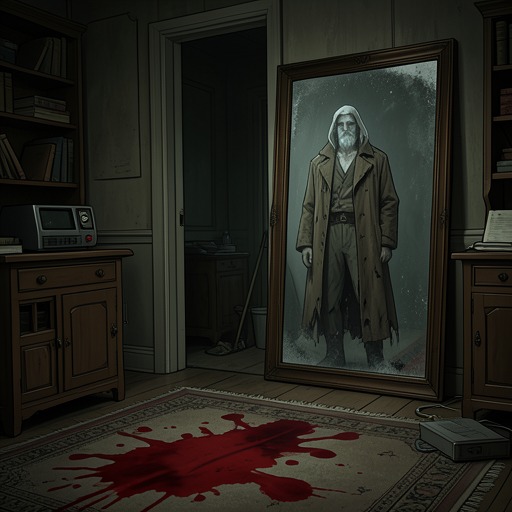
The bloodstain in the library gives Washington his first conspicuous role in the family’s dealings with the past. Mrs. Umney explains that it marks the place where Lady Eleanore de Canterville was murdered by her husband, Sir Simon de Canterville, in 1575, and says that the stain cannot be removed. Washington rejects that warning and applies Pinkerton’s Champion Stain Remover and Paragon Detergent with a small stick, scouring the floor until the mark disappears. His family admires the result, while the ensuing lightning and thunder prompt Mrs. Umney to faint; Hiram B. Otis calmly treats the weather as a complaint about the Old Country rather than a supernatural answer.
The stain’s disappearance does not settle the matter. It repeatedly returns to the locked library floor, changing from dull red to vermilion, purple, and even emerald green. The family makes a running amusement of its changing colors, but Virginia is distressed by it. Washington’s successful cleaning therefore has a double consequence: it demonstrates the family’s refusal to treat the mark as untouchable, while the stain’s recurrence makes plain that a commercial remedy cannot erase the history behind it.
When Sir Simon first appears in the corridor at one o’clock, Hiram B. Otis calmly offers him Tammany Rising Sun Lubricator for his clanking chains. The ghost retreats in indignation and drops the bottle. Washington is not identified as the person who confronts the ghost in that first encounter, but the episode establishes the household’s pattern: the apparition’s attempt to command fear is met with ordinary, practical responses rather than reverence.
Escalating Conflict with the Ghost
The family’s second encounter with the ghost follows a crash in the hall, where an old suit of armour has fallen from its stand and the ghost sits in a chair, rubbing his knees. The Otis twins fire pellets from their pea-shooters, and Hiram B. Otis covers the ghost with his revolver. The apparition escapes by passing through them, but the household’s response again denies him the fearful audience he expects. Washington’s part in this episode is not singled out; it belongs to the family conflict in which his earlier treatment of the bloodstain has already made him a particular target.
That target is explicit when the ghost plans his next expedition. He bears Washington a special grudge because he knows Washington has been removing the famous Canterville bloodstain with Pinkerton’s Paragon Detergent. The ghost intends to frighten him in his bedroom before moving on to the other members of the family, but the plan does not restore his authority. Washington’s importance in the ghost’s calculations comes not from any stated fearlessness in private, but from his repeated public interference with the sign through which the old story announces itself.
The conflict reaches its most pointed reversal in the entrance hall. The ghost, dressed for one of his established impersonations, is making satirical remarks about the photographs of Hiram B. Otis and Mrs. Otis, which have replaced the Canterville family portraits. As he heads toward the library to inspect the bloodstain, the twins leap from a dark corner and shout, “BOO!” Panicked, he rushes toward the staircase, where Washington is waiting with a large garden-syringe. Hemmed in, the ghost escapes through an unlit iron stove and reaches his room by way of the flues and chimneys, in dirt and despair. After this encounter he undertakes no further nocturnal expedition. Washington and the twins’ prank thus marks the practical end of the ghost’s attempts to haunt the household openly.
Discovery and the Secret Room
After the ghost disappears from the family’s nightly life, Washington resumes his place in a household that has largely returned to ordinary routines. He continues working alongside the rest of the family when Virginia vanishes, and he is present when she returns and says she has been with the ghost. She tells them that he is dead, that he had been wicked but was sorry, and that he gave her a box of jewels before his death.
Washington follows Virginia with a lighted candle through an opening in the wainscoting and down a narrow secret corridor. At the end of the passage, Virginia opens a great oak door studded with rusty nails. Inside, the family discovers a low, vaulted room with a small grated window. An iron ring is embedded in the wall, and chained to it lies Sir Simon’s gaunt skeleton, reaching toward a trencher and ewer set just out of reach. The vessel has green mould inside; the trencher holds only dust. The discovery exposes the physical secret behind the haunting: the ghost’s remains were chained and left without food or water in a hidden chamber. Virginia kneels to pray beside the skeleton while the others look on. Washington’s light enables the family to see what the recurring bloodstain and the ghost’s appearances had never fully explained.
The Jewels and the Family’s Resolution
The ghost’s death also leaves a question of inheritance. The jewels he gave Virginia include a magnificent ruby necklace in an old Venetian setting, and their value makes Hiram B. Otis uneasy about letting his daughter keep them. Washington is not described as speaking in the discussion with Lord Canterville, but he belongs to the family whose claim is being considered. Hiram argues that the jewels should be treated as Canterville family heirlooms and invokes the English rule of mortmain; he also stresses that they would be out of place in a household raised on Republican simplicity. He asks Lord Canterville to take the jewels to London, while Virginia wishes to retain the box as a memento of the ancestor who gave it to her.
Lord Canterville refuses to take the jewels. He says that Virginia earned them by her courage and service to Sir Simon, that no will or legal document establishes them as heirlooms, and that the family has no greater claim than Hiram’s butler. He also points to the purchase agreement: Hiram bought the furniture and the ghost at a valuation, so anything belonging to the ghost passed into the Otis family’s possession. Hiram is distressed and asks Lord Canterville to reconsider, but eventually allows Virginia to keep the gift. In the spring of 1890, when Virginia is presented at the Queen’s first drawing-room on the occasion of her marriage, her jewels attract general admiration.
Virginia marries Cecil, Duke of Cheshire, once he comes of age. Hiram personally likes the young duke but theoretically objects to titles, worrying that aristocratic life might weaken Republican simplicity; nevertheless, he walks proudly with his daughter at St. George’s, Hanover Square. Washington’s eventual place in this resolution is not separately narrated. His arc is defined instead by the contrast between the practical young man who repeatedly scours away the stain and the family witness who follows Virginia into the chamber where its underlying human tragedy is finally uncovered.